Trillium Community Forest: Ecological Goals through Local Contracting
On Whidbey Island, the Whidbey Camano Land Trust is demonstrating how conservation, community priorities, and a working forest economy can come together on the landscape. At the Trillium Community Forest, restoration forestry is helping transform a former industrial tree farm into a resilient forest that supports wildlife habitat, recreation, and sustainable timber production.
Central to this effort is a partnership with Janicki Logging, a Northwest forestry company with deep experience in restoration-focused harvesting. Together, the Land Trust and Janicki Logging implemented a long-term forest management strategy that prioritizes ecological health while supporting the region’s working forest economy.
From Tree Farm to Community Forest
Prior to its acquisition in 2010, the property was managed as a commercial tree farm and included a large harvests in the late 1980s followed by dense replanting.
Over time, those replantings created an overcrowded forest with as many as 600 trees per acre in some areas. In such dense conditions, trees compete intensely for light, water, and nutrients. The forest canopy becomes closed and dark, limiting the growth of understory plants and reducing habitat diversity.
To move the forest toward a healthier and more resilient condition, the community forest developed a restoration strategy centered on ecological thinning—selectively removing trees to give the remaining forest room to grow.
The goal isn’t simply to harvest timber. Instead, thinning helps accelerate the development of complex forest structure, encouraging larger trees, a diverse understory, and improved habitat conditions over time.
Restoration Through Active Management
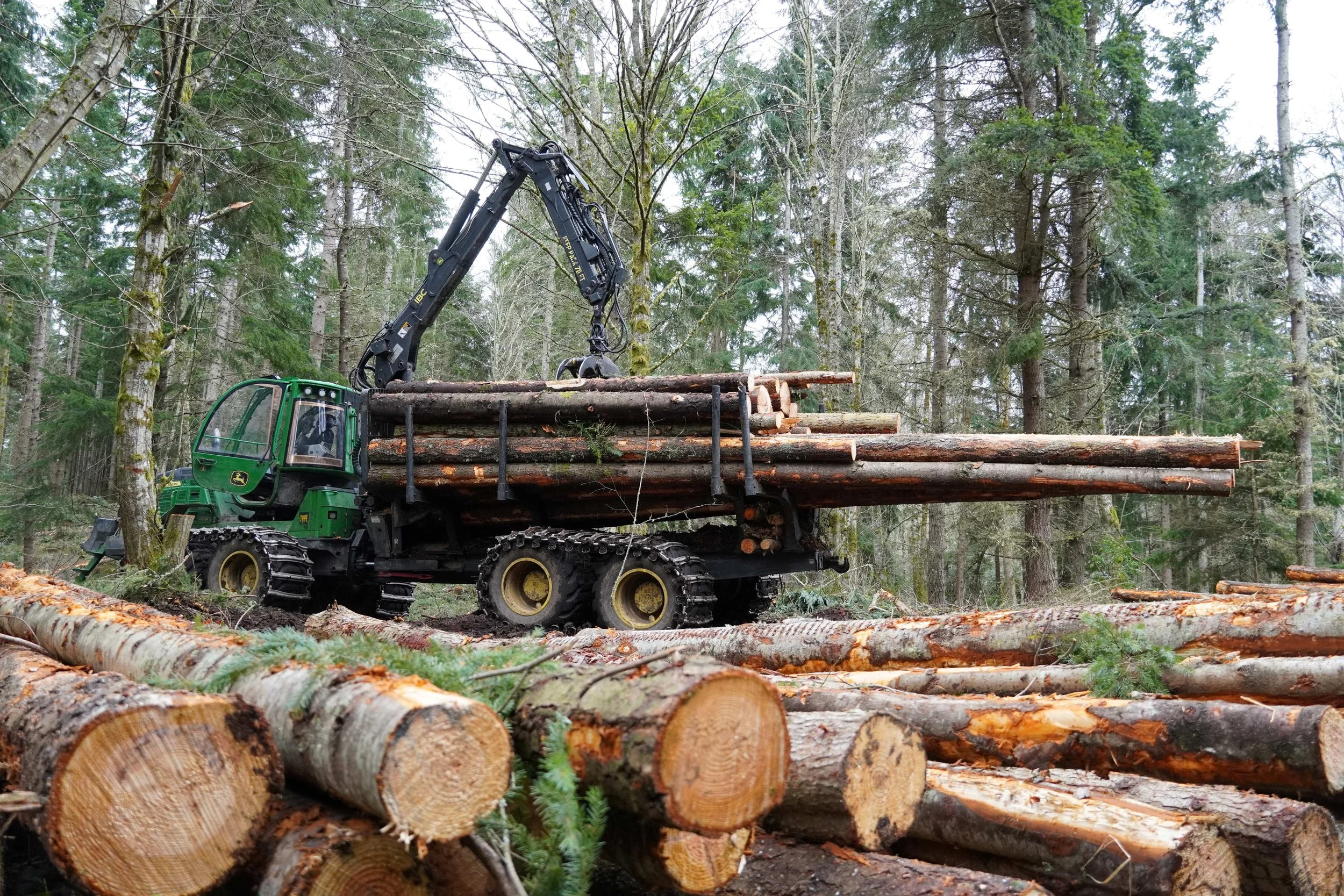
Restoration at Trillium happened gradually through multiple thinning phases. Early work reduced tree density from roughly 600 trees per acre to about 220. As sunlight reached the forest floor, the forest responded quickly—understory vegetation began to return and the remaining trees increased their growth.
The final phase of restoration reduced density to approximately 125 trees per acre. This staged approach allows the forest to adjust over time while improving resilience to storms, drought, and disease.
Carrying out this work requires skilled forestry operations that can balance ecological goals with efficient timber harvest. That’s where Janicki Logging’s expertise has been critical.
Using careful planning and low-impact harvesting practices, the logging crew is able to remove selected trees while protecting soils, waterways, and the surrounding forest.
Supporting the Working Forest Economy
A key feature of the Trillium restoration project is that it keeps forestry working on the landscape. Timber generated during thinning is sold into regional markets, helping offset restoration costs and supporting local forestry jobs.
This approach reflects a broader principle shared by many community forest advocates: healthy forests and strong rural economies are interconnected. Thoughtful forest management can generate economic value while improving long-term ecological outcomes.
A Forest Shaped by Community
As a community forest, Trillium is managed not only for ecological health but also for the people who live nearby and visit the property. The 721-acre forest protects the headwaters of three local watersheds, provides wildlife habitat, and offers trails for hiking and outdoor learning. An accessible loop trail ensures that people of all abilities can experience the forest.
Community engagement has been a key part of the restoration process. Through tours, outreach events, and open conversations, the land trust has worked closely with neighbors to explain how restoration thinning benefits the forest. Those conversations have helped build understanding and support for the work taking place on the ground.
A Model for Community Forestry
The work between Janicki and Trillium Community Forest demonstrates how collaborative stewardship can restore forest health while supporting the local economy and honoring community priorities.
By partnering with experienced forestry professionals and engaging openly with neighbors and visitors, the Whidbey Camano Land Trust is showing how community forests can balance conservation and sustainable forestry for public benefit.
Visit Janicki Logging here to learn more about their work on the Trillium Community Forest.
Visit Whidbey Camano Land Trust’s Trillum Community Forest Site here.